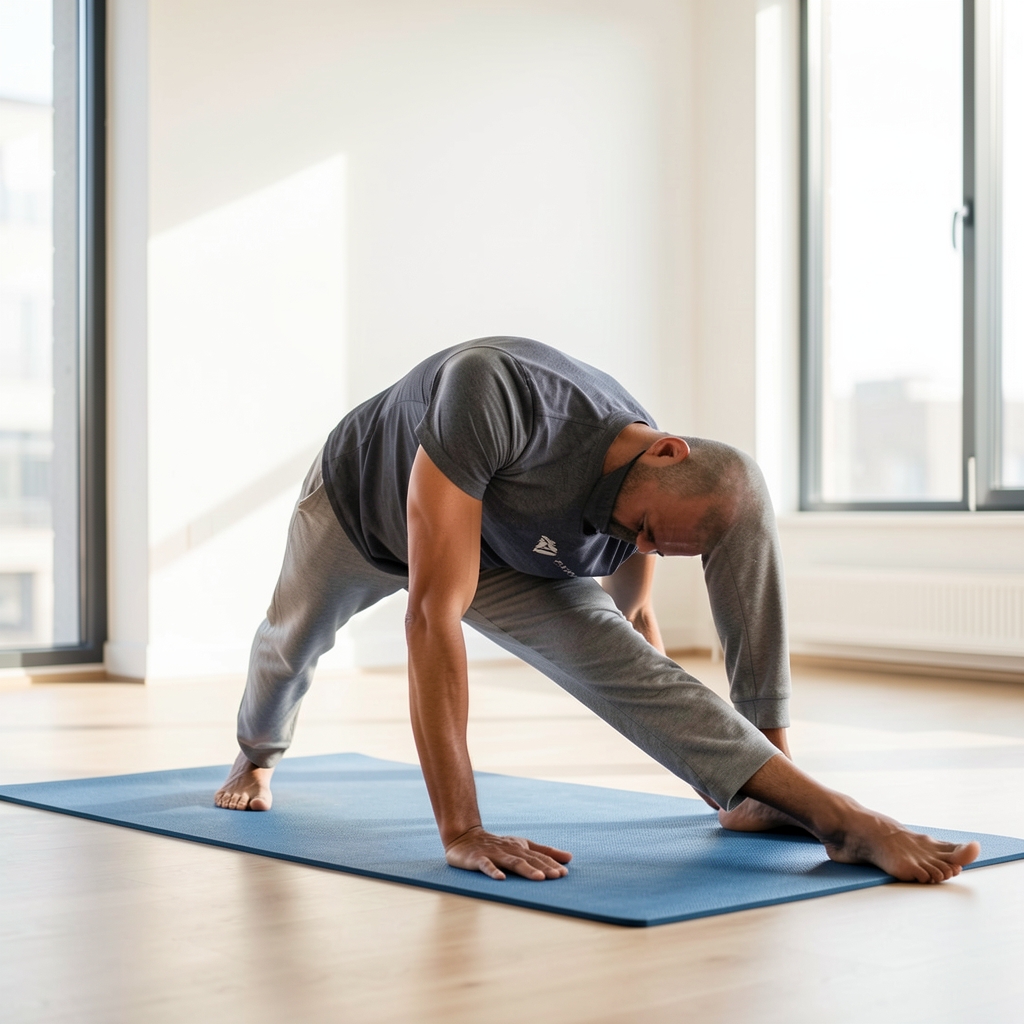
MOBILITY
Move with enough range for the life you lead.
Mobility work is most useful when it connects to a real task: running, riding, lifting, sitting, or getting down to the floor comfortably.
Range is not a standalone score. It is a relationship between a joint, the surrounding tissues, the task being attempted, the speed of movement, and the person’s current confidence. A useful practice makes that relationship easier to understand without turning discomfort into a badge of commitment.
This page describes general movement education. New pain, numbness, weakness, instability, or symptoms that persist should be discussed with an appropriately qualified local professional.
A practical sequence
- Notice: identify the movement that feels limited without forcing it.
- Prepare: use gentle, repeatable motion and steady breathing.
- Load: practice the relevant pattern at a manageable level.
- Review: stop if pain, numbness, or unusual symptoms appear.
The sequence can take five minutes beside a desk or form part of a longer warm-up. Its value is not measured by how dramatic a position looks. It is measured by whether the movement becomes clearer, calmer, and more relevant to the task that follows.
| Stage | Useful question | Record |
|---|---|---|
| Notice | Where does the movement change? | Side, position, and sensation |
| Prepare | Does gentle motion improve control? | Breathing and ease |
| Load | Can the pattern be used in context? | Task quality, not depth |
| Review | What changed later in the day? | Comfort and confidence |

Comfort is useful feedback
Mobility is not a test of virtue. A small regular practice that supports movement can be more meaningful than an occasional demanding routine.
Different tasks ask for different qualities. A cyclist may value comfortable hip and thoracic positions, a runner may pay attention to foot and ankle control, and a lifter may need a stable setup that can be repeated. None of these contexts requires a single universal routine.
- Choose movements that resemble the task without copying it exactly.
- Use a slow range that permits clear breathing and control.
- Compare left and right without assuming they must be identical.
- Stop when sensation becomes sharp, electrical, or difficult to interpret.
A calmer mobility roadmap
Begin with one or two movements, practice them on several ordinary days, and review whether they support the activity you care about. Add complexity only when the basic pattern is familiar. The aim is a dependable relationship with movement, not a performance for the mirror.
“The useful range is the range you can understand, control, and bring into the rest of your day.”
Solace is based at Jalan Cempaka Putih Raya No. 15, RT.8/RW.5, Cempaka Putih Barat, Kota Jakarta Pusat, Daerah Khusus Ibukota Jakarta 10520, Indonesia. Phone +62 21 726 1835.